Thermal overload relay
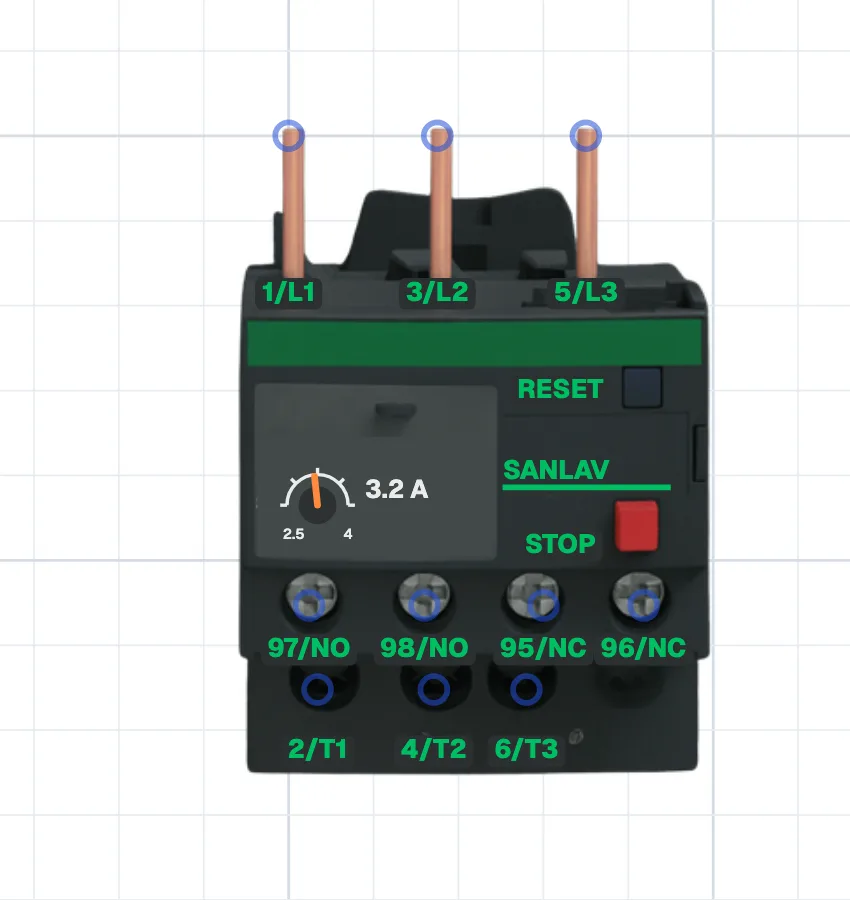
What is a thermal overload relay?
A thermal overload relay is a protective device that guards a motor against sustained overcurrent. If the current through the motor rises above the set value and stays there for a while, the relay trips and its contact cuts the control circuit, dropping out the contactor. It is usually mounted directly under the contactor.
What does a thermal overload relay do and where is it used?
When a motor jams, the load increases, a phase is lost or the windings are strained, the motor draws more current than normal and heats up. The overload relay detects this and stops the motor before the windings burn. It is used in pump, fan, compressor and conveyor panels and in every contactor-based motor starter.
Setting and selecting an overload relay
The relay is chosen so that its setting range covers the motor's rated current, and the dial is set to the current on the motor nameplate. It has one normally closed (NC) contact and one normally open (NO) contact: the NC contact cuts the control circuit, the NO contact is used for a fault lamp or alarm. A tripped relay is reset by hand with the reset button or automatically, depending on its setting.
What to watch out for
If the setting is higher than the motor current the relay cannot protect the motor; if it is lower, it trips for no reason. In star-delta starting the setting depends on where the relay is connected. An overload relay does not protect against short circuits; a fuse or motor protection circuit breaker is needed for that. Automatic reset is not used on machines where an unexpected restart would be dangerous.
Terminals
Overload relay
- Inputs (from the contactor)
- 1/L1, 3/L2, 5/L3
- Outputs (to the motor)
- 2/T1, 4/T2, 6/T3
- Control contact (NC)
- 95-96
- Signal contact (NO)
- 97-98
Try it in the simulator.
This component is in CoilPath with its real look. Add it to a circuit, wire it and see how it behaves in the simulation.
Circuits that use this component
- Direct-On-Line Starting Circuit for an Induction Motor
- Seal-in Circuit (Continuous Running of an Induction Motor with a Relay)
- Jog Button with Momentary Running and Seal-in Cancel Circuit
- Seal-in Circuit with Start–Stop Control from Three Locations
- Forward–Reverse Direct-On-Line Starting Circuit
- Sequential Induction Motor Starting with Timer Relays
- Delayed Stop Circuit with a Timer Relay
- Sequential Induction Motor Starting and Delayed Stop with Timer Relays
- Direct-On-Line Starting Circuit with Protection and Indicator Lamps
- Automatic Motor Stopping at Set Positions with Sensors
- Forward–Reverse Motor Circuit with PNP Sensors
- Star-Delta Starting Circuit for an Induction Motor