Motor control circuits
Forward–Reverse Direct-On-Line Starting Circuit
What is a forward-reverse motor control circuit?
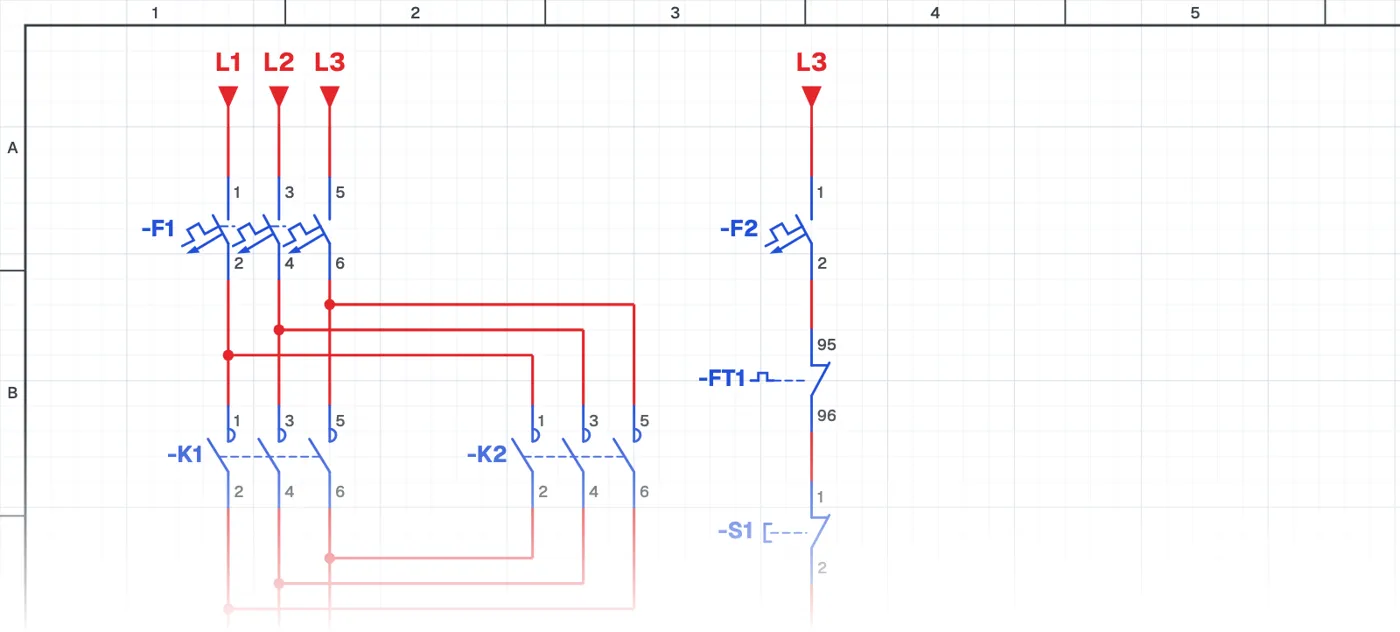
A forward-reverse control circuit runs a three-phase induction motor in both directions. The direction of a three-phase motor is reversed by swapping two of its supply phases. This is done with two contactors, one for forward and one for reverse. The circuit is also known as a reversing starter or motor direction control circuit.
Where is a forward-reverse circuit used?
It is used in cranes and hoists, garage and industrial doors, lifts, reversing conveyors, machine tools, mixers and screw conveyors. Wherever a mechanism has to move back and forth, there is a forward-reverse circuit.
Power circuit and control circuit
In the power circuit the two contactors are arranged to connect the motor phases in two different orders; the overload relay protects the motor in both directions. The control circuit has a start button for each direction, a common stop button and the two contactors. Drawing and reading the phase swap in the power circuit correctly is the part that needs the most care.
Why is the interlock important?
If both contactors energize at once, two phases are short-circuited. To prevent this the contactors interlock each other with their normally closed contacts (electrical interlock); some circuits also interlock with the buttons. A forward-reverse circuit with no interlock or a wrongly wired one causes serious faults on site. How the interlock is built is explained step by step in the book and can be tried in the app's simulator.
Parts used
- Motor 3~
- M1
- Start button (NO)
- S2, S3
- Contactor coil
- K1, K2
Run it in the simulator.
This circuit is ready in the CoilPath library. Open it, press the buttons and follow the current. It also comes with a wiring view and a panel layout.
Related circuits
- Sequential Induction Motor Starting with Timer Relays
- Delayed Stop Circuit with a Timer Relay
- Sequential Induction Motor Starting and Delayed Stop with Timer Relays
- Direct-On-Line Starting Circuit with Protection and Indicator Lamps
- Automatic Motor Stopping at Set Positions with Sensors
- Forward–Reverse Motor Circuit with PNP Sensors