Motor control circuits
Star-Delta Starting Circuit for an Induction Motor
What is star-delta starting?
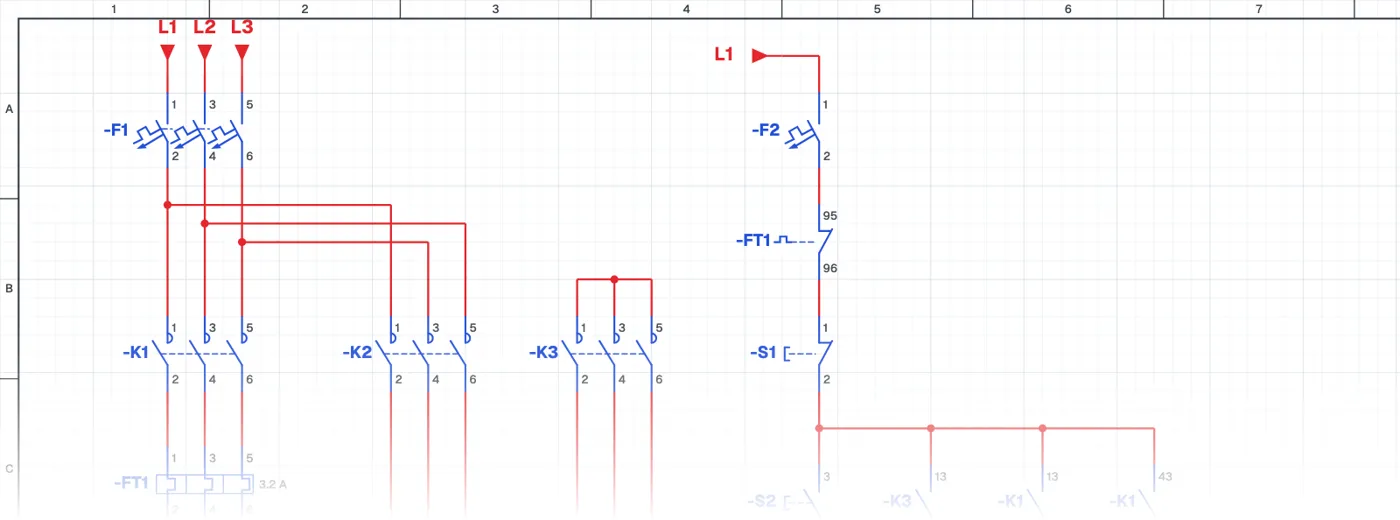
Star-delta starting is a method used to reduce the starting current of large three-phase induction motors. The motor first starts with its windings in star; each winding then sees a lower voltage, so the current drawn from the supply is lower. After a set time the windings are switched to delta and the motor runs at full power. A timer relay sets the changeover time.
Where is star-delta starting used?
It is used for pumps, fans, extractors, compressors, mills and large conveyors. With direct-on-line starting a motor draws several times its rated current; on large motors this inrush causes voltage dips and tripped breakers. Star-delta starting reduces it to about one third, which is why it is one of the most used starting methods on site.
Power circuit and control circuit
The power circuit has three contactors: main (line), star and delta. All six motor terminals (U1-V1-W1 and U2-V2-W2) are brought to the panel. The control circuit has these three contactors, a timer relay, an overload relay and start-stop buttons. The interlock between the star and delta contactors is the most critical point: if both energize together, there is a short circuit.
What to watch out for
The motor's delta voltage on the nameplate must match the supply voltage; a motor for star-delta starting must be one that runs in delta. The timer is set long enough for the motor to reach speed. If the overload relay is in the line carrying winding current, it is set to about 0.58 times the motor's rated current. Starting torque also drops, so other methods may be preferred for machines that start under heavy load.
Parts used
- Contactor coil
- K3, K1, K2
Run it in the simulator.
This circuit is ready in the CoilPath library. Open it, press the buttons and follow the current. It also comes with a wiring view and a panel layout.