Induction motor (three-phase)
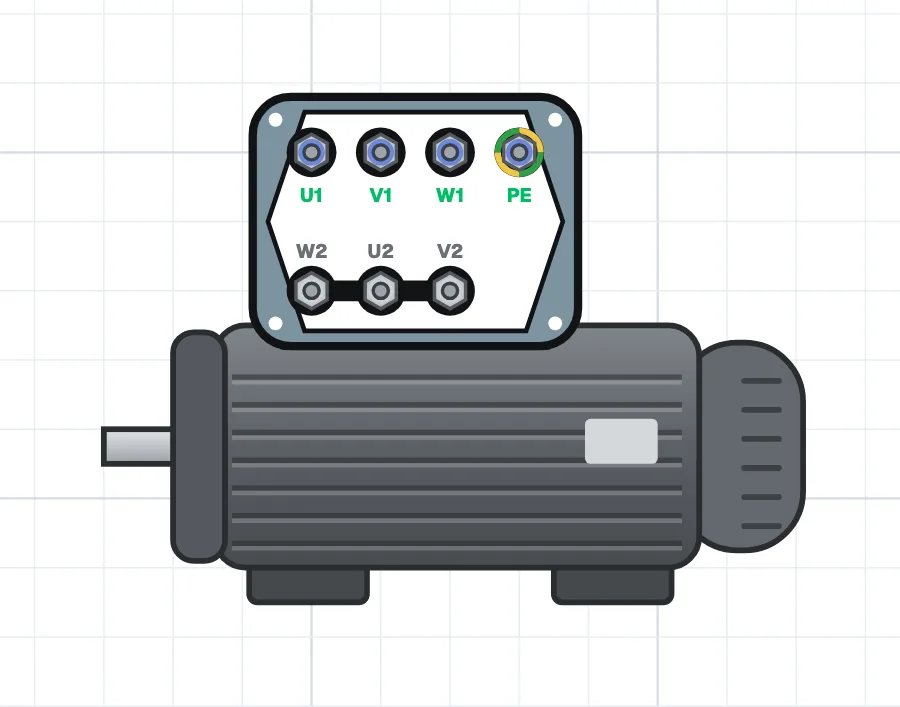
What is an induction motor?
The induction motor (asynchronous motor) is the most widely used electric motor in industry. Its stator, supplied from a three-phase network, creates a rotating magnetic field that turns the rotor. Thanks to its simple design, ruggedness and low maintenance, it is used everywhere from pumps to conveyors.
Where is an induction motor used?
It is used in pumps, fans, compressors, conveyors, cranes, mixers, mills, machine tools and almost every industrial machine. It can be started direct-on-line with a contactor, with star-delta or with a frequency drive; swapping two phases reverses its direction.
Star and delta connection
The motor terminal box has six terminals: U1, V1, W1 and U2, V2, W2. These are connected in star or delta with links. Which connection is used depends on the voltage on the motor nameplate and the supply voltage. Motors with all six terminals brought to the panel can be started star-delta.
What to watch out for
The voltage, current, power and connection data on the nameplate are the basis for selection and protection. The motor frame must always be earthed. The overload relay or motor protection circuit breaker is set to the nameplate current. Check the direction of rotation on first start.
Terminals
Induction motor
- Phase terminals
- U1, V1, W1
- Protective earth
- PE
Induction motor (6 leads)
- Winding starts
- U1, V1, W1
- Winding ends
- U2, V2, W2
- Earth
- PE
Try it in the simulator.
This component is in CoilPath with its real look. Add it to a circuit, wire it and see how it behaves in the simulation.
Circuits that use this component
- Contactor Connection
- Contactor Connection with a Phase-Neutral Coil
- Contactor Connection with a Phase-to-Phase Coil
- Direct-On-Line Starting Circuit for an Induction Motor
- Induction Motor Jog (Inching) Circuit
- Seal-in Circuit (Continuous Running of an Induction Motor)
- Seal-in Circuit (Continuous Running of an Induction Motor with a Relay)
- Jog Button with Momentary Running and Seal-in Cancel Circuit
- Seal-in Circuit with Start–Stop Control from Three Locations
- Forward–Reverse Direct-On-Line Starting Circuit
- Sequential Induction Motor Starting with Timer Relays
- Delayed Stop Circuit with a Timer Relay