Motor control circuits
Contactor Connection
What is a contactor?
A contactor is an electromechanical switch that energizes when voltage reaches its coil and closes its main contacts to supply a load. A small control current switches high-current loads such as motors, heaters and pumps. The main contacts are used in the power circuit, the coil and auxiliary contacts in the control circuit. When the coil voltage is removed, the contactor de-energizes and the load is switched off.
Where is a contactor connection used?
Switching a motor directly with a circuit breaker is neither safe nor suitable for remote or automatic control. That is why motors in industry, buildings and irrigation panels are always run through a contactor. Every automation system, whether it uses buttons, float switches, sensors, timer relays or a PLC, ends up energizing a contactor coil.
Power circuit and control circuit
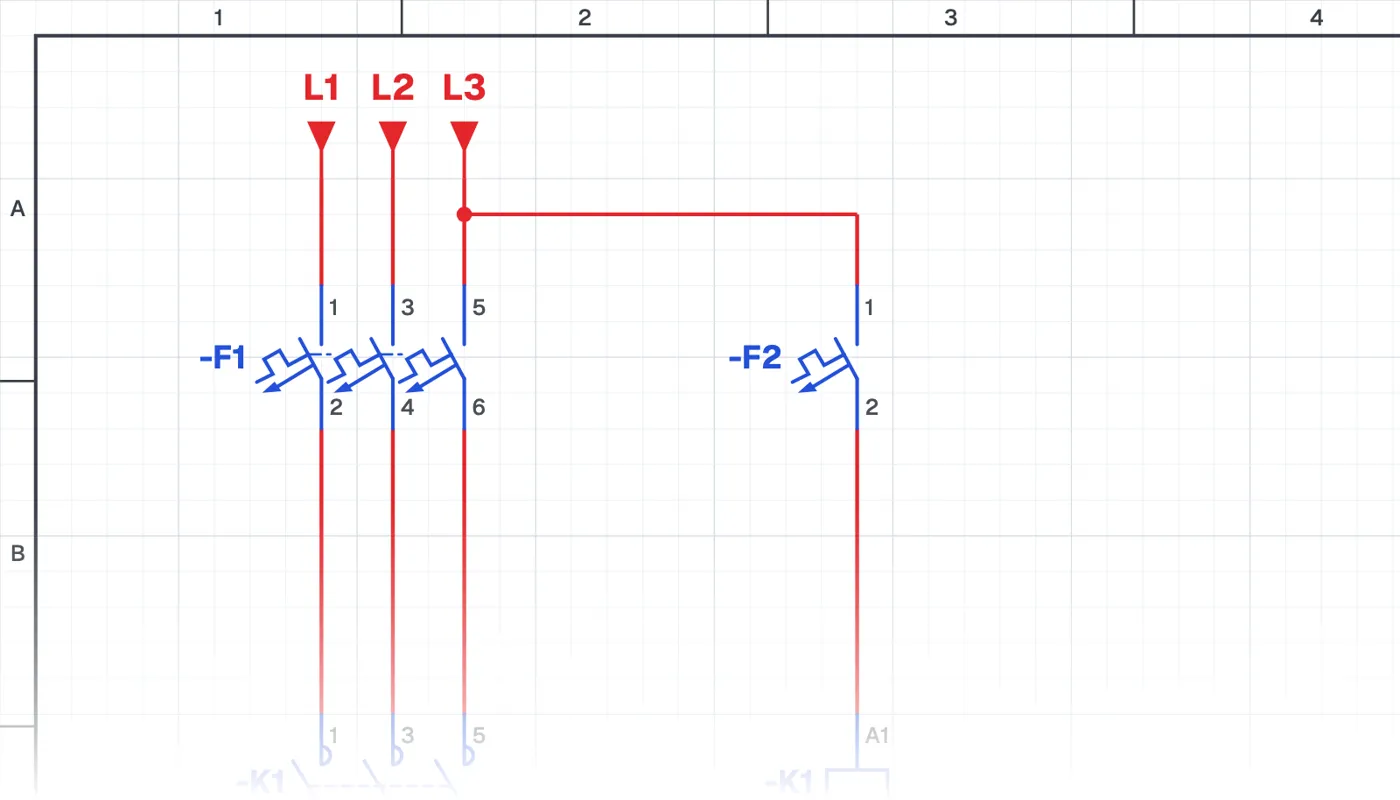
This circuit clearly shows the two basic parts of motor control. In the power circuit the three phases go through a circuit breaker and the contactor's main contacts to the motor. In the control circuit the contactor coil is supplied through its own circuit breaker. Panel drawings always follow this split: the power circuit drives the motor, the control circuit drives the contactor. Seeing this split is the first step in learning to read control schematics.
How to choose a contactor
The coil voltage must match the control circuit voltage. The current rating is chosen by motor power and duty; for motor loads the AC-3 rating in the catalogue is used. If the control circuit needs a seal-in, an interlock or indicator lamps, check that there are enough auxiliary contacts.
Parts used
- Motor 3~
- M1
Run it in the simulator.
This circuit is ready in the CoilPath library. Open it, press the buttons and follow the current. It also comes with a wiring view and a panel layout.
Related circuits
- Contactor Connection with a Phase-Neutral Coil
- Contactor Connection with a Phase-to-Phase Coil
- Direct-On-Line Starting Circuit for an Induction Motor
- Induction Motor Jog (Inching) Circuit
- Seal-in Circuit (Continuous Running of an Induction Motor)
- Seal-in Circuit (Continuous Running of an Induction Motor with a Relay)