Motor control circuits
Dahlander Motor High Speed – Low Speed Circuit
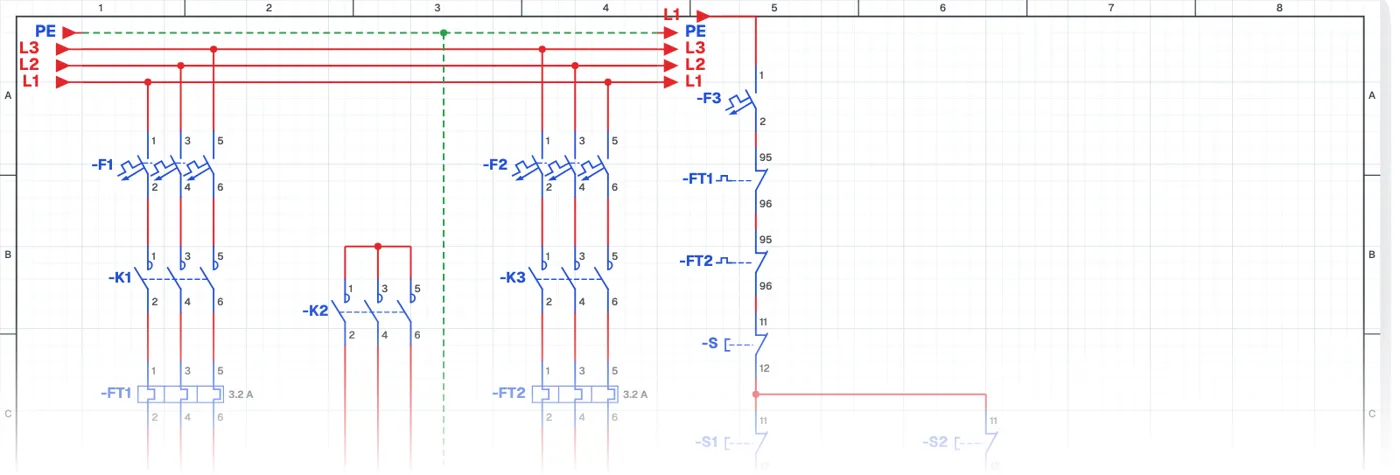
What is a Dahlander motor?
A Dahlander motor is a three-phase induction motor that runs at two different speeds by changing how its windings are connected. At low speed the windings are in delta, at high speed in double star; the high speed is twice the low speed. This circuit runs a Dahlander motor at low and high speed.
Where is a Dahlander motor used?
It is used on two-speed fans and extractors, machine tools, washing machines, hoists and conveyors that need two speeds. It is a simple and robust way to get two fixed speeds without a frequency drive.
Power circuit and control circuit
The power circuit has three contactors: one for low speed and two for high speed. All six motor terminals are brought to the panel and each speed has its own overload relay. In the control circuit, the interlocks that stop both speeds from running at once are the most important part.
What to watch out for
Each speed has a different current, so the two overload relays are set separately. The motor terminals are connected according to the nameplate diagram; with a wrong connection the motor can turn in different directions at the two speeds.
Parts used
- Circuit breaker (3-pole)
- F1, F2
- Overload relay
- FT1, FT2
- Stop button (NC)
- S, S1, S2
- Start button (NO)
- S2, S1
- Contactor coil
- K1, K2, K3
Run it in the simulator.
This circuit is ready in the CoilPath library. Open it, press the buttons and follow the current. It also comes with a wiring view and a panel layout.