Timer relay
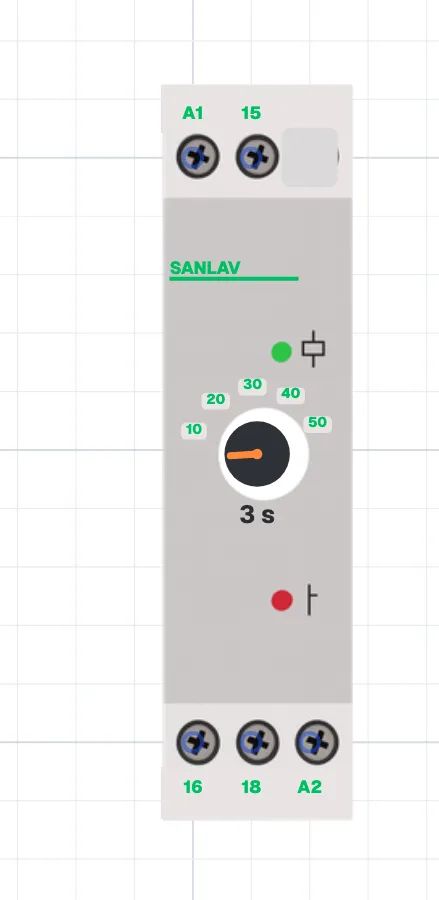
What is a timer relay?
A timer relay changes its contact when a set time has passed after it is supplied or triggered. In control circuits it is used to start or end a job after a certain delay. The time is set on the front dials, from seconds to hours.
Where is a timer relay used?
It is used to set the star-to-delta changeover time in star-delta starting, to start motors in sequence, to stop fans with a delay, for staircase lighting, irrigation, washing and mixing, and other timed processes. It is one of the most used components in control panels.
Types of timer relay
The most common type is the on-delay timer: after it is supplied, it changes its contact when the time runs out. There are also off-delay, flasher (cyclic) and star-delta timers. On multifunction timers the function is chosen with a selector on the front. Timers are chosen by supply voltage (24 V, 230 V and so on) and number of contacts.
What to watch out for
On multifunction relays always check that the correct function is selected. When setting the time, both the time range (seconds, minutes) and the time dial must be in the right position. Relay contacts have limited current; large loads are switched through a contactor, not directly.
Terminals
Timer relay
- Supply
- A1, A2
- Common
- 15
- Normally closed
- 16
- Normally open
- 18
Try it in the simulator.
This component is in CoilPath with its real look. Add it to a circuit, wire it and see how it behaves in the simulation.
Circuits that use this component
- Sequential Induction Motor Starting with Timer Relays
- Delayed Stop Circuit with a Timer Relay
- Sequential Induction Motor Starting and Delayed Stop with Timer Relays
- Star-Delta Starting Circuit for an Induction Motor
- Star-Delta Starting Circuit with Forward–Reverse Control
- Manual and Automatic Star–Delta Starting with Float Switch – 1
- Manual and Automatic Star–Delta Starting with Float Switch – 2