Contactor
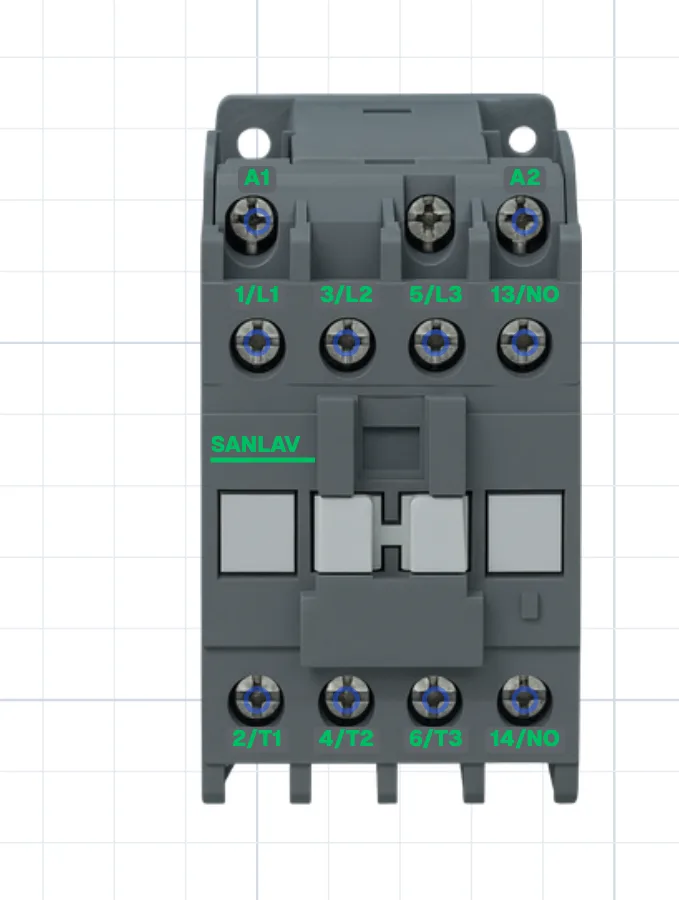
What is a contactor?
A contactor is an electromechanical switch that pulls in when voltage is applied to its coil and closes its contacts to energize a load. It lets a small control current switch high-current loads such as motors, heaters, pumps and lighting groups. It has main contacts wired into the power circuit, auxiliary contacts used in the control circuit, and a coil.
What does a contactor do and where is it used?
It is the basic component of electrical control circuits. Contactors are used in motor control panels, pump and fan panels, compressors, lift and crane controls, lighting automation and heating systems. A control device such as a push button, float switch, sensor, timer relay or PLC energizes the contactor coil, and the contactor energizes the load. That way the load can be controlled remotely and automatically.
Contactor types and selection
Contactors are chosen by coil voltage (24 V DC, 230 V AC, 400 V AC and so on), number of poles and current rating. For motor loads, the current or kW rating in utilization category AC-3 in the catalogue is used. If there are not enough auxiliary contacts, an auxiliary contact block is clipped onto the front; blocks with NO (normally open) and NC (normally closed) contacts are available. Small contactors with no main contacts, used only for control logic, are called control relays or auxiliary contactors.
What to watch out for when using a contactor
The coil voltage must match the control voltage; at the wrong voltage the coil either does not pull in or burns out. A contactor alone does not protect the motor against overcurrent, so a thermal overload relay or motor protection circuit breaker is used with it. In circuits such as forward-reverse and star-delta, contactors that must never close together are interlocked. Contacts wear over time and should be checked regularly on frequently switched systems.
Terminals
Contactor
- Coil
- A1, A2
- Power inputs
- 1/L1, 3/L2, 5/L3
- Power outputs
- 2/T1, 4/T2, 6/T3
- Auxiliary contact (normally open)
- 13-14
Contactor (2NO + 2NC)
- Coil
- A1+, A2-
- Normally open contacts
- 13-14, 43-44
- Normally closed contacts
- 21-22, 31-32
Contact block (NC + NO)
- Normally closed
- 21-22
- Normally open
- 43-44
Try it in the simulator.
This component is in CoilPath with its real look. Add it to a circuit, wire it and see how it behaves in the simulation.
Circuits that use this component
- Contactor Connection
- Contactor Connection with a Phase-Neutral Coil
- Contactor Connection with a Phase-to-Phase Coil
- Direct-On-Line Starting Circuit for an Induction Motor
- Induction Motor Jog (Inching) Circuit
- Seal-in Circuit (Continuous Running of an Induction Motor)
- Seal-in Circuit (Continuous Running of an Induction Motor with a Relay)
- Jog Button with Momentary Running and Seal-in Cancel Circuit
- Seal-in Circuit with Start–Stop Control from Three Locations
- Forward–Reverse Direct-On-Line Starting Circuit
- Sequential Induction Motor Starting with Timer Relays
- Delayed Stop Circuit with a Timer Relay