Miniature circuit breaker (MCB)
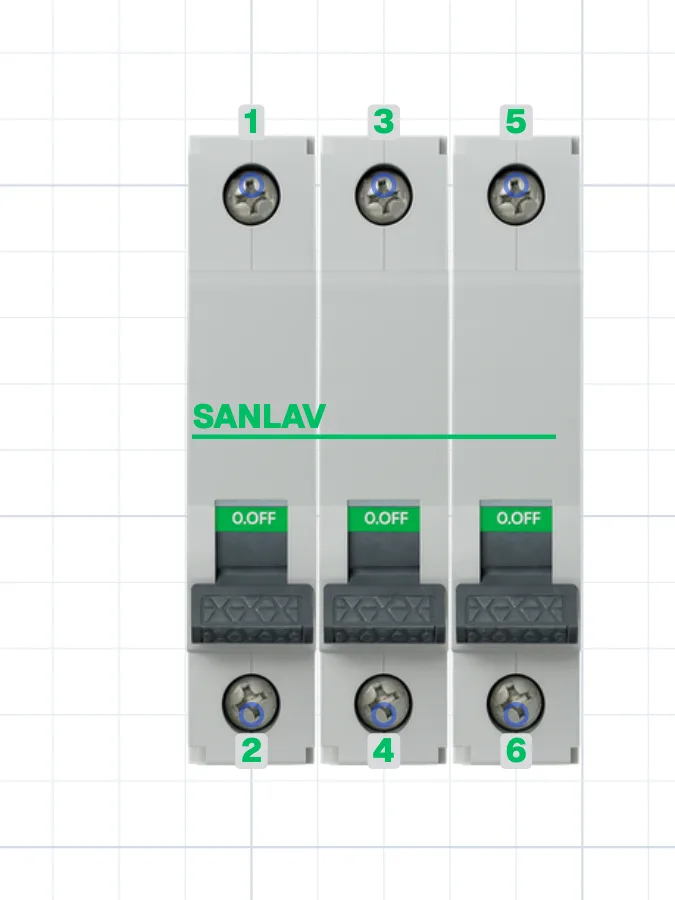
What is a miniature circuit breaker?
A miniature circuit breaker (MCB) protects a line against overload and short circuit and can be switched back on after it trips. It contains a thermal release for overload and a magnetic release for short circuit. Unlike a cartridge fuse it is not replaced after tripping; the lever is simply switched back up.
Where is an MCB used?
It is used in residential, commercial and industrial panels to protect lighting and socket circuits, control circuits and small motor lines. Control panels usually have a three-pole MCB for the power circuit and a one- or two-pole MCB for the control circuit.
Types and selection
MCBs are chosen by number of poles (1, 2, 3, 4), rated current (6 A, 10 A, 16 A and so on) and tripping curve. Curve B is for general loads such as lighting and sockets, curve C for motors and loads with inrush current, and curve D for loads with very high inrush. An auxiliary contact fitted on the side reports the breaker's position to the control circuit or PLC.
What to watch out for
The MCB's current rating is chosen to suit the cross-section of the cable it protects; protecting the cable is its main job. Its breaking capacity (6 kA, 10 kA and so on) must cover the short-circuit current where it is installed. An MCB alone does not fully protect a motor against sustained overcurrent; motors also need an overload relay or motor protection circuit breaker.
Terminals
Circuit breaker (1-pole)
- Input
- 1
- Output
- 2
Circuit breaker (2-pole)
- Inputs
- 1, 3
- Outputs
- 2, 4
Three-pole circuit breaker
- Inputs
- 1, 3, 5 (L1, L2, L3)
- Outputs
- 2, 4, 6
Auxiliary contact
- Common
- 1 (C)
- Normally closed
- 2 (NC)
- Normally open
- 4 (NO)
Try it in the simulator.
This component is in CoilPath with its real look. Add it to a circuit, wire it and see how it behaves in the simulation.
Circuits that use this component
- Contactor Connection
- Contactor Connection with a Phase-Neutral Coil
- Contactor Connection with a Phase-to-Phase Coil
- Direct-On-Line Starting Circuit for an Induction Motor
- Induction Motor Jog (Inching) Circuit
- Seal-in Circuit (Continuous Running of an Induction Motor)
- Seal-in Circuit (Continuous Running of an Induction Motor with a Relay)
- Jog Button with Momentary Running and Seal-in Cancel Circuit
- Seal-in Circuit with Start–Stop Control from Three Locations
- Forward–Reverse Direct-On-Line Starting Circuit
- Sequential Induction Motor Starting with Timer Relays
- Delayed Stop Circuit with a Timer Relay