Residual current protection
Direct-on-Line Starter with Residual Current Protection
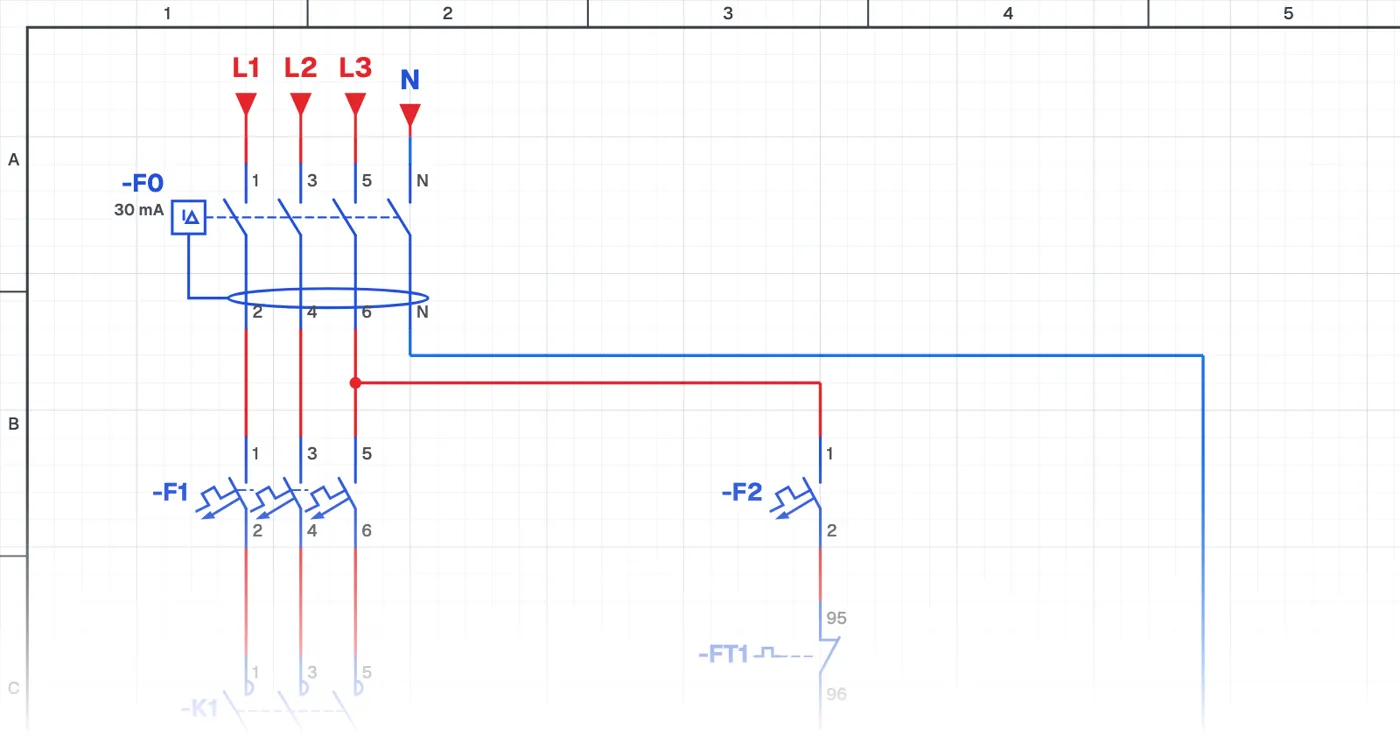
What is a residual current device (RCD)?
A residual current device (RCD, also called RCCB or ground fault circuit interrupter) is a protective device that compares the current going into a circuit with the current coming back. If the difference, the current leaking to earth, exceeds a set value, it cuts the circuit. It protects people from electric shock and the installation from fire.
Where is an RCD used?
It is used in homes, workplaces, construction sites, irrigation and livestock facilities and motor panels. Regulations make residual current protection mandatory in many installations. It is especially important for pumps and motors working in wet places.
Power circuit and control circuit
In this circuit the supply of a direct-on-line starter passes through a four-pole RCD. The control circuit is also supplied from the RCD's output. The neutral must always pass through the RCD; a load whose neutral returns around the RCD trips it even when there is no leakage.
What to watch out for
For protection of life a 30 mA device is usually used, for fire protection 300 mA. The RCD should be tested with its test button at regular intervals. For motors with frequency drives, a suitable RCD type (such as type B) is chosen.
Parts used
- Motor 3~
- M1
Run it in the simulator.
This circuit is ready in the CoilPath library. Open it, press the buttons and follow the current. It also comes with a wiring view and a panel layout.