Residual current device (RCD)
What is a residual current device?
A residual current device (RCD, RCCB, also known as a GFCI) compares the current going into a circuit with the current coming back. If the difference, the current leaking to earth, exceeds a set value, it disconnects the circuit within milliseconds. It protects people from electric shock and the installation from fire.
Where is an RCD used?
It is used in homes, workplaces, construction sites, bathrooms and wet areas, irrigation and livestock facilities, and motor and pump panels. Regulations make residual current protection mandatory in many installations. It is vital for pumps and motors that come into contact with water.
Types and selection
Two-pole RCDs are used on single-phase lines and four-pole RCDs on three-phase lines. A sensitivity of 30 mA is usually chosen for protection of life and 300 mA for fire protection. There are types AC, A, F and B; in circuits with electronic loads such as frequency drives, a suitable type (usually A or B) is chosen. An RCD does not protect against short circuits, so a fuse or breaker is used with it.
What to watch out for
The neutral must pass through the RCD and must not be joined to another circuit's neutral after it; otherwise the RCD trips for no reason. The test button is used at regular intervals to check that it works. An RCD that trips often signals a real leakage in the installation, and its source must be found.
Terminals
Two-pole residual current device (RCD)
- Inputs
- 1, N (L, N)
- Outputs
- 2, N
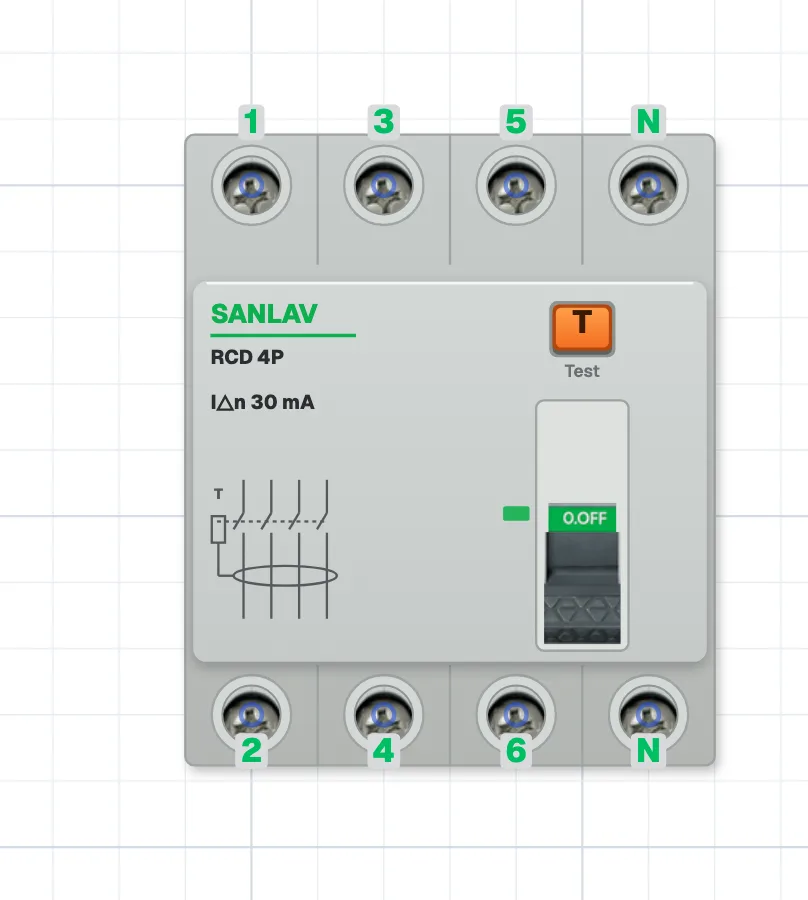
Four-pole residual current device (RCD)
- Inputs
- 1, 3, 5, N (L1, L2, L3, N)
- Outputs
- 2, 4, 6, N
Try it in the simulator.
This component is in CoilPath with its real look. Add it to a circuit, wire it and see how it behaves in the simulation.