Selector switch
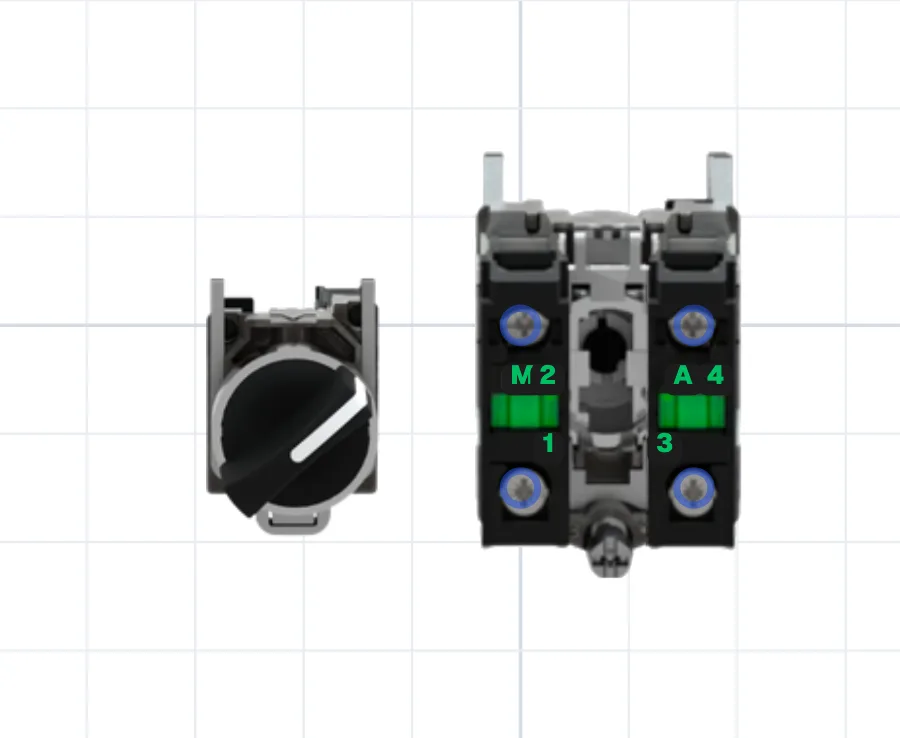
What is a selector switch?
A selector switch is a control device that changes position when turned and closes different contacts in each position. Unlike a push button, it does not spring back when released; it stays in the selected position.
Where is a selector switch used?
It is used in pump panels for hand-off-auto (MAN-0-AUTO) selection and to choose which of two pumps runs, on machines to select an operating mode, for forward-0-reverse direction selection and to enable a system. It is mounted on the panel door.
Types
There are two- and three-position types; on three-position types the middle position is usually off (0). Maintained and spring-return versions and key-operated (locking) versions are available. The number and type of contact blocks behind it decide which contact closes in which position.
What to watch out for
The meaning of each position (M, 0, A and so on) should be clearly marked on the panel door. Know whether the manual position bypasses level and safety protections and use it accordingly. Contact blocks are wired according to the switching table.
Terminals
Selector switch
- Normally open contact
- 1-2
- Normally open contact
- 3-4
MAN–AUTO selector switch
- M (manual)
- 1-2, closes in position M
- A (automatic)
- 3-4, closed in position A
Try it in the simulator.
This component is in CoilPath with its real look. Add it to a circuit, wire it and see how it behaves in the simulation.
Circuits that use this component
- Forward–Reverse Motor Circuit with PNP Sensors
- Manual and Automatic Pump Operation
- Manual Pump Operation with Self-Holding and Automatic Operation by Float Switch
- Running One of Two Pumps with a Selector Switch
- Two-Pump Level Control Circuit with Selector Switch and Phase Monitoring Relay
- Float-Controlled Sequential Operation of Two Motors
- Float-Controlled Sequential Operation of Two Motors 2
- Manual and Automatic Pump Starting with Selector Switch and Float Switch (Contactor with Line-to-Line Coil)
- Manual and Automatic Star–Delta Starting with Float Switch – 1
- Manual and Automatic Star–Delta Starting with Float Switch – 2
- Manual and Automatic Pump Operation in a Two-Tank Water Transfer System with Liquid Level Relay
- Manual and Automatic Pump Operation Using a Liquid Level Relay (NO Contact) and Float Switch