Float switch
What is a float switch?
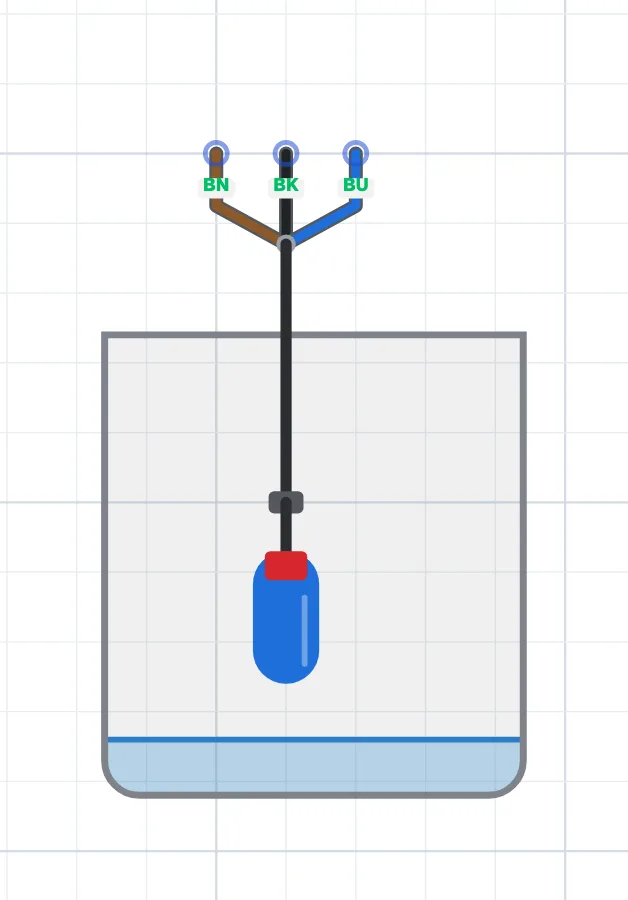
A float switch is a level switch whose position changes with the liquid level in a tank, opening and closing its contact accordingly. On cable types, the float at the end of the cable tilts up as the water rises and hangs down as it falls, and the contact inside changes over.
Where is a float switch used?
It is used in water tanks, booster systems, irrigation ponds, drainage and septic pits and wells to run pumps automatically and prevent dry running. It is the simplest and cheapest way to sense level in pump control.
Types and selection
There are cable (hanging) float switches, rod float switches and mechanical float switches. Cable float switches usually have a changeover contact: one contact is used to fill a tank, the other to empty it. The cable length and the position of the counterweight set the working level range. For drinking water, choose a float switch made of certified material.
What to watch out for
The float switch contact is used to supply the contactor coil, not the motor directly. The float must move freely in the tank and not catch on the pump inlet or pipes. In wastewater pits floats get dirty over time and should be checked regularly.
Terminals
Float switch (cable)
- Black (BK)
- common (C)
- Blue (BU)
- normally open (NO)
- Brown (BN)
- normally closed (NC)
Try it in the simulator.
This component is in CoilPath with its real look. Add it to a circuit, wire it and see how it behaves in the simulation.
Circuits that use this component
- Automatic Pump Operation with an Upper-Level Float Switch
- Automatic Pump Operation with a Lower-Level Float Switch
- Automatic Tank Filling Control with Lower and Upper Float Switches
- Manual and Automatic Pump Operation
- Manual Pump Operation with Self-Holding and Automatic Operation by Float Switch
- Running One of Two Pumps with a Selector Switch
- Two-Pump Level Control Circuit with Selector Switch and Phase Monitoring Relay
- Float-Controlled Sequential Operation of Two Motors
- Float-Controlled Sequential Operation of Two Motors 2
- Manual and Automatic Pump Starting with Selector Switch and Float Switch (Contactor with Line-to-Line Coil)
- Manual and Automatic Star–Delta Starting with Float Switch – 1
- Manual and Automatic Star–Delta Starting with Float Switch – 2