Pump and level control
Liquid Level Relay – Two-Tank Water Transfer System
What is a two-tank water transfer system?
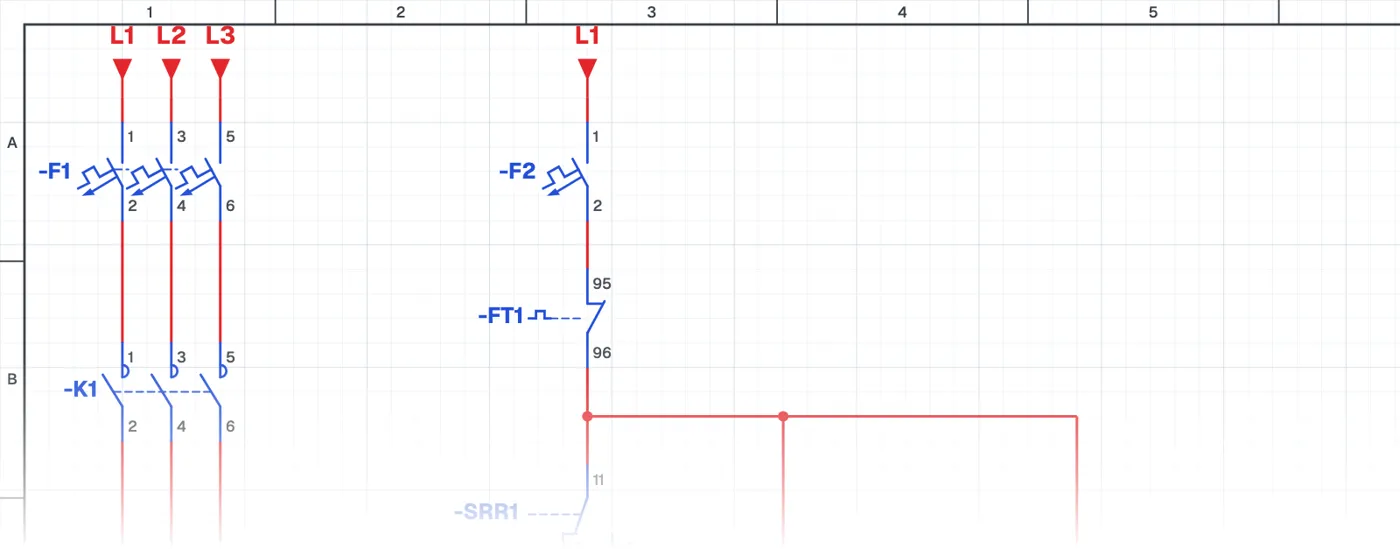
It is an automatic water transfer circuit in which a pump moves water from a source tank to a target tank, protected by two liquid level relays. The source tank relay prevents the pump from running dry and the target tank relay prevents overflow.
Where is it used?
It is used where water is moved from a well to a roof tank, from an underground tank to a building tank or from a collection pond to an irrigation tank. It is a very common application in buildings and industrial plants.
Power circuit and control circuit
The power circuit is the pump motor, circuit breaker, contactor and overload relay. The control circuit uses the contacts of two liquid level relays together. It is a good example of how to wire contacts when two conditions must be met at the same time.
What to watch out for
Each tank has its own electrode set and relay. If the electrode cables run a long distance, check that the relay is suitable for that distance.
Parts used
- Motor 3~
- M1
- Liquid level relay (SRR)
- SRR1, SRR2
Run it in the simulator.
This circuit is ready in the CoilPath library. Open it, press the buttons and follow the current. It also comes with a wiring view and a panel layout.
Related circuits
- Manual and Automatic Pump Operation in a Two-Tank Water Transfer System with Liquid Level Relay
- Manual and Automatic Pump Operation Using a Liquid Level Relay (NO Contact) and Float Switch
- Manual and Automatic Pump Control with Signalling, Using a Liquid Level Relay (NO Contact) and Float Switch
- Automatic Pump Operation with an Upper-Level Float Switch
- Automatic Pump Operation with a Lower-Level Float Switch
- Automatic Tank Filling Control with Lower and Upper Float Switches