Liquid level relay
What is a liquid level relay?
A liquid level relay (level control relay) senses the level of a liquid with electrodes hung in the tank and changes its contact accordingly. Thanks to a very small current flowing between the electrodes, it can tell which electrode the water has reached. Usually a reference, a low-level and a high-level electrode are used.
Where is a liquid level relay used?
It is used in water tanks, narrow wells and boreholes, booster tanks, wastewater and drainage tanks, and water transfer systems between two tanks. With no moving parts it fails less often than a float switch and can be used where a float does not fit.
Types and selection
Relays are chosen by supply voltage, number of contacts and sensitivity adjustment. Because they have changeover contacts, they can be used to fill or to empty a tank. Some models have adjustable delay and sensitivity. The electrodes are made of stainless steel.
What to watch out for
Electrodes scale up and get dirty over time and should be cleaned at intervals. For liquids with low conductivity, such as pure water, the sensitivity is increased. If the electrode cables run a long distance, check that the relay is suitable for it; the reference electrode is placed lowest.
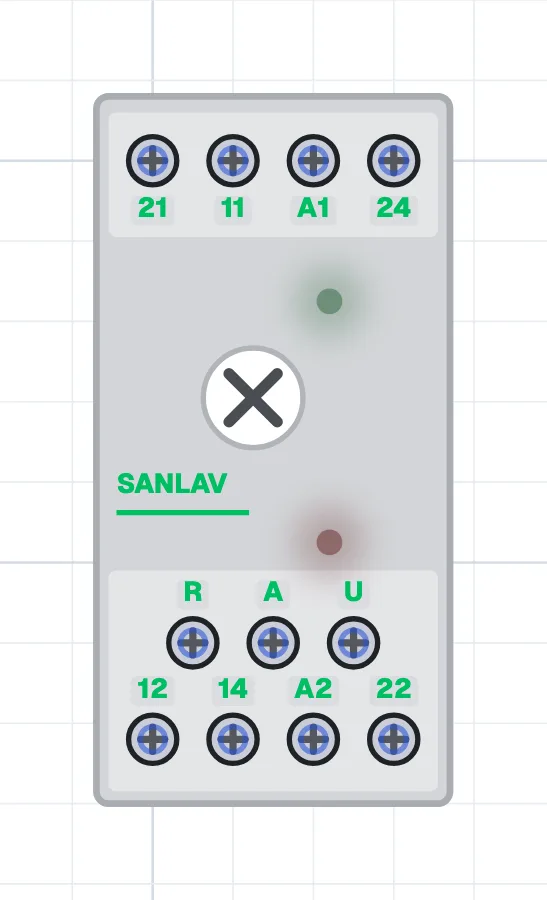
Terminals
Liquid level relay
- Supply
- NC
- 11-12, closed without water
- NO
- 11-14, closes when the water reaches U
- Reference, lower and upper-level electrode
- Second contact
- 21 common, 21-22 closed with no water, 21-24 closed when water reaches U
Tank with electrodes
- Reference electrode (at the bottom)
- Lower-level electrode
- Upper-level electrode
Try it in the simulator.
This component is in CoilPath with its real look. Add it to a circuit, wire it and see how it behaves in the simulation.
Circuits that use this component
- Liquid Level Relay – NO Contact Circuit Application
- Liquid Level Relay – NC Contact Circuit Application
- Liquid Level Relay – Two-Tank Water Transfer System
- Manual and Automatic Pump Operation in a Two-Tank Water Transfer System with Liquid Level Relay
- Manual and Automatic Pump Operation Using a Liquid Level Relay (NO Contact) and Float Switch
- Manual and Automatic Pump Control with Signalling, Using a Liquid Level Relay (NO Contact) and Float Switch