Pump and level control
Liquid Level Relay – NO Contact Circuit Application
What is a liquid level relay?
A liquid level relay senses the water level with electrodes hung in the tank and changes its contact accordingly. Because water conducts, a small current flows between the electrodes; the relay uses this to tell which electrode the water has reached. This circuit uses the relay's normally open (NO) contact to empty a tank.
Where is it used?
It is used in narrow wells, tanks where a float switch does not fit or could get stuck, boreholes, wastewater and drainage tanks. With no moving parts, it fails less often than a float switch.
Power circuit and control circuit
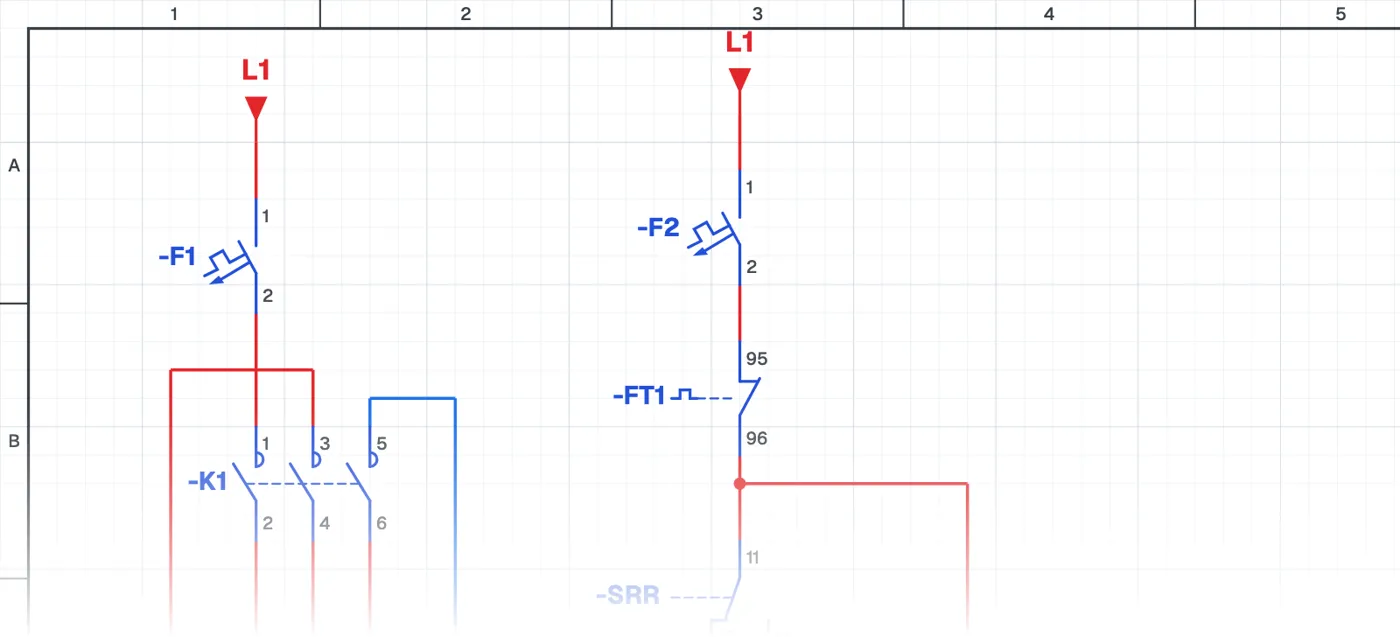
The power circuit is a single-phase pump motor with a circuit breaker, contactor and overload relay. The control circuit has the liquid level relay's supply, electrodes and contact. Which contact of the relay is used decides whether the pump fills or empties.
What to watch out for
Electrodes scale up and get dirty over time and need cleaning at intervals. In liquids with very low conductivity, such as pure water, the relay may not sense the level; the relay's sensitivity is set for the liquid.
Parts used
- Circuit breaker (1-pole)
- F1, F2
Run it in the simulator.
This circuit is ready in the CoilPath library. Open it, press the buttons and follow the current. It also comes with a wiring view and a panel layout.
Related circuits
- Liquid Level Relay – NC Contact Circuit Application
- Liquid Level Relay – Two-Tank Water Transfer System
- Manual and Automatic Pump Operation in a Two-Tank Water Transfer System with Liquid Level Relay
- Manual and Automatic Pump Operation Using a Liquid Level Relay (NO Contact) and Float Switch
- Manual and Automatic Pump Control with Signalling, Using a Liquid Level Relay (NO Contact) and Float Switch
- Automatic Pump Operation with an Upper-Level Float Switch