Pump and level control
Liquid Level Relay – NC Contact Circuit Application
What is tank filling with a liquid level relay?
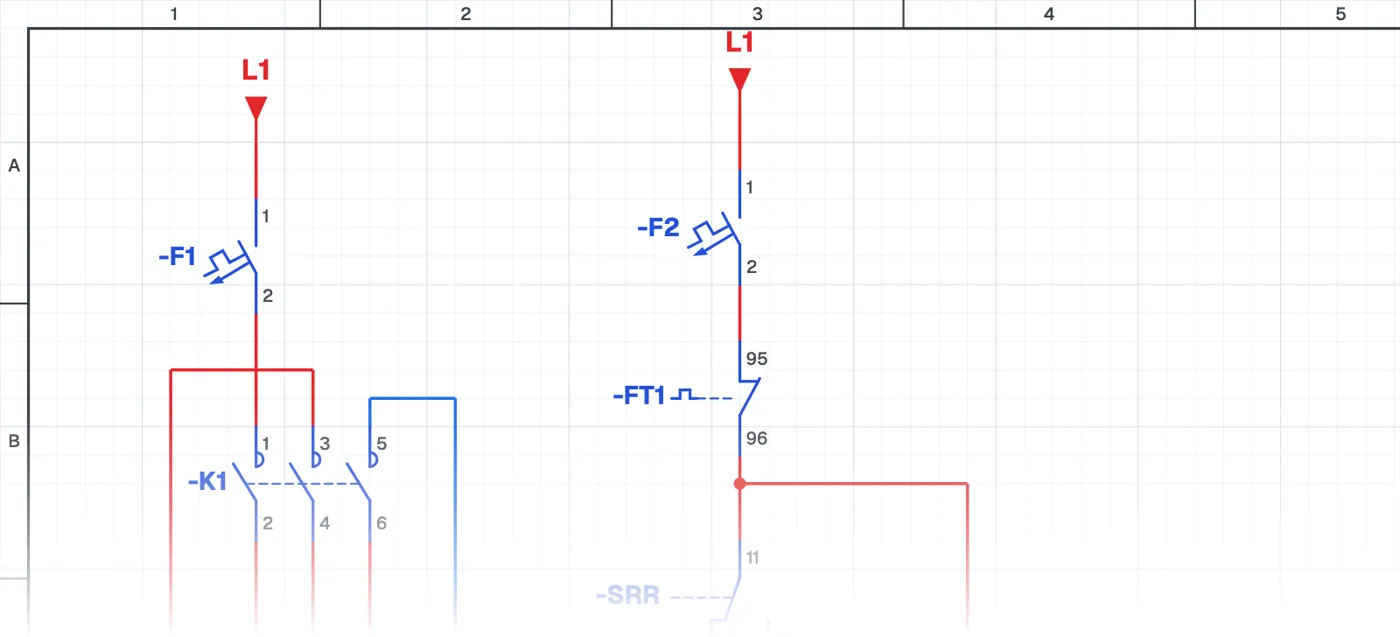
In this control circuit a tank is filled automatically using the liquid level relay's normally closed (NC) contact. When the tank is low the pump runs, when it is full the pump stops. A working range forms between the lower and upper level electrodes.
Where is it used?
It is used in building water tanks, booster systems, industrial water tanks and livestock facilities. Level control with electrodes is precise and needs little maintenance.
Power circuit and control circuit
The power circuit is the pump motor, circuit breaker, contactor and overload relay. The control circuit uses the relay's NC contact. Compared with the emptying circuit that uses the NO contact, it shows how the same relay does a completely different job with a different contact.
What to watch out for
The lengths of the lower and upper electrodes are set to leave a range that keeps the pump from starting and stopping too often. The common (reference) electrode is placed at the bottom.
Parts used
- Circuit breaker (1-pole)
- F1, F2
Run it in the simulator.
This circuit is ready in the CoilPath library. Open it, press the buttons and follow the current. It also comes with a wiring view and a panel layout.
Related circuits
- Liquid Level Relay – Two-Tank Water Transfer System
- Manual and Automatic Pump Operation in a Two-Tank Water Transfer System with Liquid Level Relay
- Manual and Automatic Pump Operation Using a Liquid Level Relay (NO Contact) and Float Switch
- Manual and Automatic Pump Control with Signalling, Using a Liquid Level Relay (NO Contact) and Float Switch
- Automatic Pump Operation with an Upper-Level Float Switch
- Automatic Pump Operation with a Lower-Level Float Switch