Phase monitoring relay
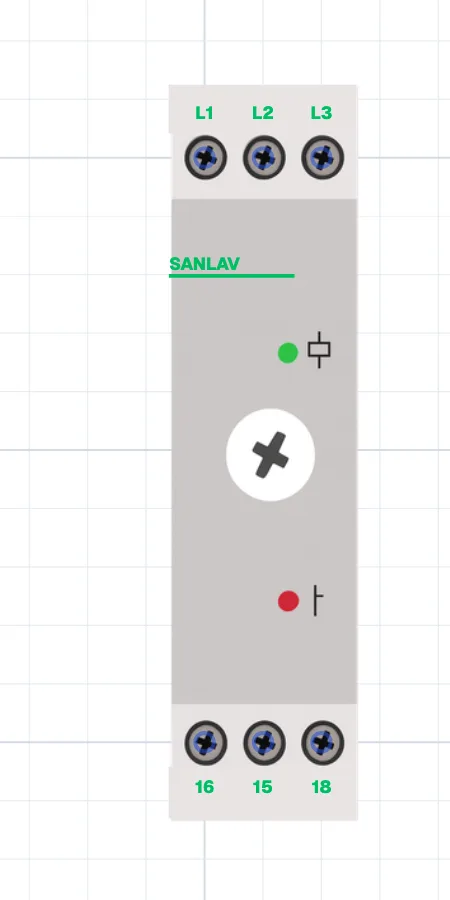
What is a phase monitoring relay?
A phase monitoring relay (phase failure and phase sequence relay) watches a three-phase supply and changes its contact when there is a problem. It detects phase loss, wrong phase sequence, under- or overvoltage and imbalance between phases.
What does a phase monitoring relay do and where is it used?
A three-phase motor running with one phase missing heats up and burns out quickly; with the wrong phase sequence it runs backwards. The phase monitoring relay cuts the control circuit in these cases and stops or blocks the motor. It is used in pump, compressor, lift, crane and refrigeration panels, and especially in motor panels in rural areas.
Types and selection
Simple models monitor only phase loss and phase sequence; advanced models let you set under- and overvoltage, imbalance and delay time. Some also detect a lost neutral. The relay is chosen for the supply voltage and mounted on a DIN rail; it has a changeover contact.
What to watch out for
Voltage and delay settings are made for the supply conditions; settings that are too tight cause nuisance stops. The relay's contacts cut the control circuit, not the motor itself. If a phase sequence fault appears on first start-up, two phases are swapped.
Terminals
Phase monitoring relay
- Phase inputs
- L1, L2, L3
- Common
- 15
- Closed on phase fault
- 16
- Closed when phases are correct
- 18
Try it in the simulator.
This component is in CoilPath with its real look. Add it to a circuit, wire it and see how it behaves in the simulation.
Circuits that use this component
- Direct-On-Line Starting Circuit with Protection and Indicator Lamps
- Two-Pump Level Control Circuit with Selector Switch and Phase Monitoring Relay
- Float-Controlled Sequential Operation of Two Motors
- Float-Controlled Sequential Operation of Two Motors 2
- Manual and Automatic Pump Control with Signalling, Using a Liquid Level Relay (NO Contact) and Float Switch