Motor protection circuit breaker
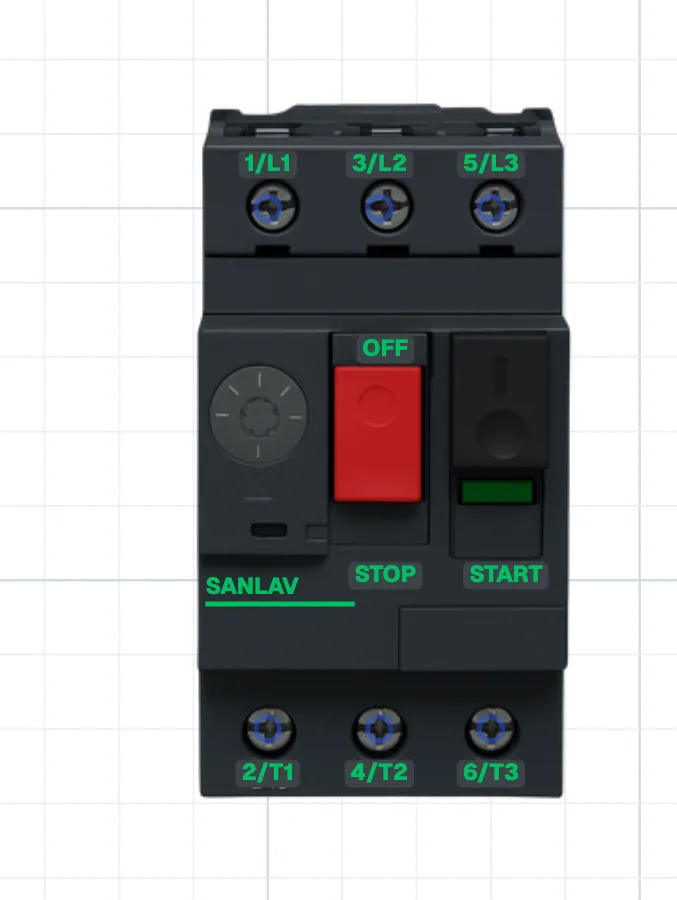
What is a motor protection circuit breaker?
A motor protection circuit breaker (MPCB, motor circuit breaker) combines the jobs of a fuse and a thermal overload relay in one housing. It protects the motor against both short circuits and sustained overcurrent. It can be switched on and off by hand with the knob or buttons on its front.
Where is a motor protection circuit breaker used?
It is used in panels for motors such as pumps, fans, compressors, conveyors and mixers, especially in automation panels with several motors. Compared with a separate fuse and overload relay, it takes up less space in the panel and simplifies wiring.
Types and selection
Motor protection circuit breakers are chosen by current setting range; the dial is set to the rated current on the motor nameplate. Auxiliary contact and trip-indication blocks can be added, so the control circuit or PLC knows whether the breaker is on, off or tripped. Used together with a contactor, the motor can be controlled remotely and automatically.
What to watch out for
The current setting must match the motor's rated current. The breaking capacity must suit the short-circuit current at the point of installation. On its own it does not allow remote control; for automatic operation it is used with a contactor.
Terminals
Motor protection breaker
- Inputs
- 1/L1, 3/L2, 5/L3
- Outputs (to the motor)
- 2/T1, 4/T2, 6/T3
Try it in the simulator.
This component is in CoilPath with its real look. Add it to a circuit, wire it and see how it behaves in the simulation.