Inductive sensor
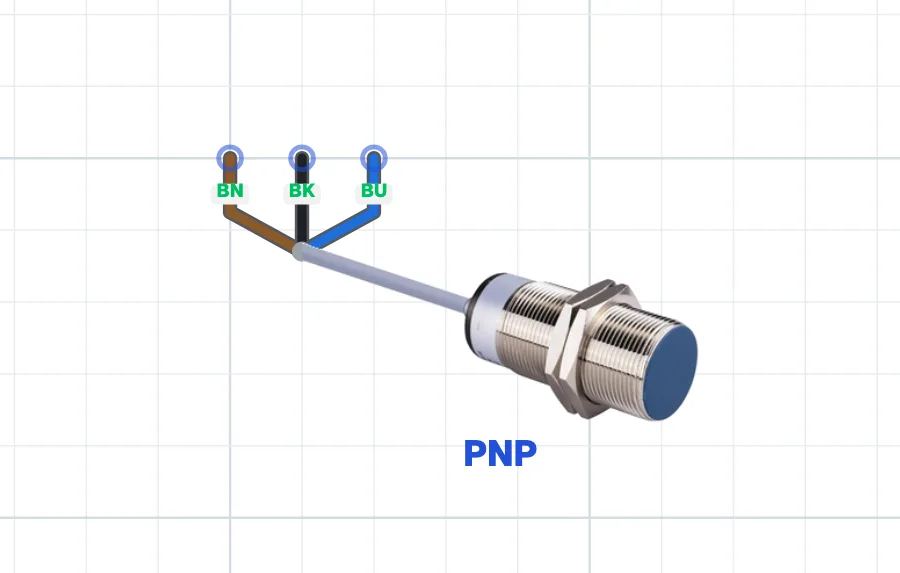
What is an inductive sensor?
An inductive sensor (inductive proximity sensor) detects only metal objects without touching them. When a metal object enters the magnetic field at its front face, its output changes. With no moving parts, it has a long life.
Where is an inductive sensor used?
It is used to detect metal parts on conveyors, to detect positions and end points on machines, to count gear teeth and shaft revolutions, to check cylinder positions and for counting. It is one of the most common sensors in automation.
Types and selection
Inductive sensors are chosen by sensing distance, housing diameter (M8, M12, M18, M30), output type and connection. Three-wire types have a PNP or NPN output; two-wire types are wired in series with the load and work like a switch; four-wire types have both NO and NC outputs. Wire colours are usually brown (+), blue (−) and black (output).
What to watch out for
The sensor's output type (PNP or NPN) must match the PLC or relay input it is connected to. Sensing distance depends on the metal; it is shorter for metals other than steel. Mount the sensor at a distance where the target part cannot hit it.
Terminals
Inductive sensor
- Brown (BN)
- supply +
- Blue (BU)
- supply -
- Black (BK)
- output
Inductive sensor (2-wire)
- Brown (BN) - Blue (BU)
- in series with the load
Inductive sensor (4-wire)
- Brown (BN)
- supply +
- Blue (BU)
- supply -
- Black (BK)
- NO output
- White (WH)
- NC output
Try it in the simulator.
This component is in CoilPath with its real look. Add it to a circuit, wire it and see how it behaves in the simulation.
Circuits that use this component
- Automatic Motor Stopping at Set Positions with Sensors
- Forward–Reverse Motor Circuit with PNP Sensors
- Garage Door with a PLC
- Box Size Sorting with a PLC
- Tank Filling and Emptying with a PLC
- Double Conveyor with a PLC
- Two-Liquid Mixer with a PLC
- Box Sorter with a PLC
- Production Line Counting with a PLC
- Product Counting with HMI