Moulded case circuit breaker (MCCB)
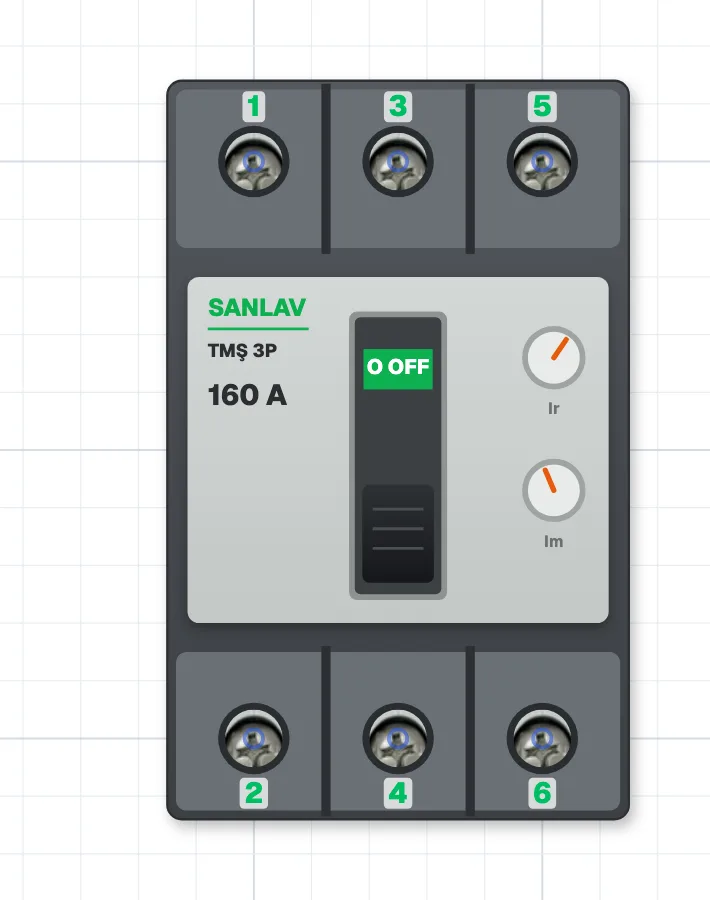
What is a moulded case circuit breaker (MCCB)?
A moulded case circuit breaker (MCCB, compact breaker) protects high-current lines against overload and short circuit. It has a thermal release for overload and a magnetic release for short circuit. It works at much higher currents than miniature circuit breakers, and most models have adjustable trip settings.
Where is an MCCB used?
It is used at the incomer of main distribution boards, at transformer outputs, on the supply of large motor and power factor correction panels, and on main lines in factories and buildings. The main switch that turns off a whole building or plant is usually an MCCB.
Types and selection
MCCBs come in three- and four-pole versions, with rated currents usually between 100 A and 1600 A. On adjustable models the overload (Ir) and short-circuit (Im) trip values are set separately. Selection takes into account the rated current, breaking capacity and, if needed, accessories such as motor operators or auxiliary contacts.
What to watch out for
Settings are made according to the cable size and selectivity with the protective devices in downstream panels. The breaking capacity must not be lower than the installation's short-circuit current. Terminal screws are tightened to the manufacturer's torque; a loose connection at high current causes heating and fire.
Terminals
Three-pole molded case circuit breaker (MCCB)
- Inputs (L1, L2, L3)
- Outputs (to the board)
Four-pole molded case circuit breaker (MCCB)
- Inputs (L1, L2, L3, N)
- Outputs (to the board)
Try it in the simulator.
This component is in CoilPath with its real look. Add it to a circuit, wire it and see how it behaves in the simulation.