Cartridge fuse
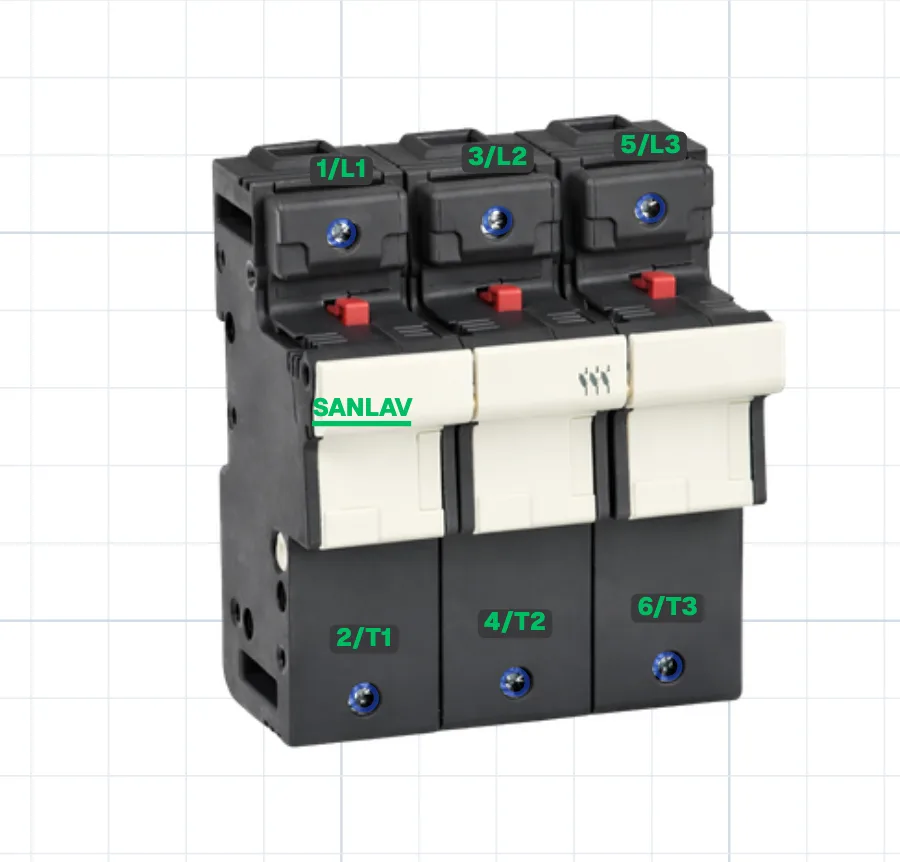
What is a cartridge fuse?
A cartridge fuse is a single-use fuse whose internal element melts and opens the circuit on a short circuit or overcurrent. It sits in a fuse holder or fuse base; when it blows it is taken out and replaced. Cylindrical and blade-type (NH) fuses are available.
Where is a cartridge fuse used?
It is used in control circuits, motor and transformer supplies, the inputs of frequency drives and power electronics, and on the DC side of solar PV systems. Because it clears short-circuit current very fast, it is preferred for protecting sensitive equipment.
Types and selection
Cartridge fuses are chosen by size, rated current and characteristic. Type gG is for general line protection, type aM for motor protection, and very fast types protect semiconductors. Fuse holders come in one-, two- and three-pole versions; some have an indicator lamp that shows a blown fuse.
What to watch out for
A blown fuse is always replaced with one of the same rating and type; fitting a larger fuse leaves the line unprotected. Before replacing it, find the cause of the fault and make sure the holder is de-energized. A cartridge fuse does not protect a motor against sustained overcurrent; motors also need an overload relay.
Terminals
Cartridge fuse (1-pole)
- Input
- 1
- Output
- 2
Cartridge fuse (3-pole)
- Inputs
- 1/L1, 3/L2, 5/L3
- Outputs
- 2/T1, 4/T2, 6/T3
Try it in the simulator.
This component is in CoilPath with its real look. Add it to a circuit, wire it and see how it behaves in the simulation.