Capacitive sensor
What is a capacitive sensor?
A capacitive sensor is a proximity sensor that detects metal and non-metal objects without touching them. It can detect plastic, glass, wood, paper, water and granules. It can even see some materials through a thin wall.
Where is a capacitive sensor used?
It is used to detect liquid and granule levels in tanks and silos, to detect plastic and cardboard, to detect products on packaging lines, to check bottle filling and to count boxes.
Types and selection
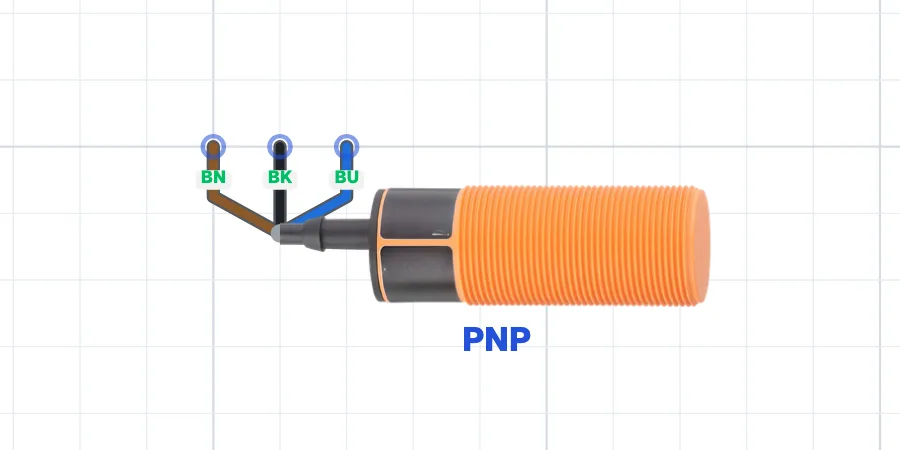
Like inductive sensors, there are two-, three- and four-wire types; three-wire types have a PNP or NPN output. Most have an adjustment screw for sensitivity. Flush and non-flush mounting types and different housing diameters are available.
What to watch out for
Sensitivity must be set for the material and environment; setting it too high makes it detect dust and moisture too. For tank level detection, the material and thickness of the tank wall are taken into account. The output type is chosen to match the input it connects to.
Terminals
Capacitive sensor
- Brown (BN)
- supply +
- Blue (BU)
- supply -
- Black (BK)
- output
Capacitive sensor (2-wire)
- Brown (BN) - Blue (BU)
- in series with the load
Capacitive sensor (4-wire)
- Brown (BN)
- supply +
- Blue (BU)
- supply -
- Black (BK)
- NO output
- White (WH)
- NC output
Try it in the simulator.
This component is in CoilPath with its real look. Add it to a circuit, wire it and see how it behaves in the simulation.