Relay (control relay)
What is a relay?
A relay is a small electromechanical switch that pulls in when voltage reaches its coil and changes over its contacts. Relays used in control panels are also called control relays or interface relays. They usually plug into a socket (relay base), so they can be replaced without touching the wiring.
What does a relay do and where is it used?
It controls one circuit with a small signal from another: energizing a contactor with the small contact of a sensor, PLC output or push button, doing several jobs with one command, or separating circuits at different voltages. Relays are very common in automation panels, at PLC outputs and in lift and machine controls.
Types and selection
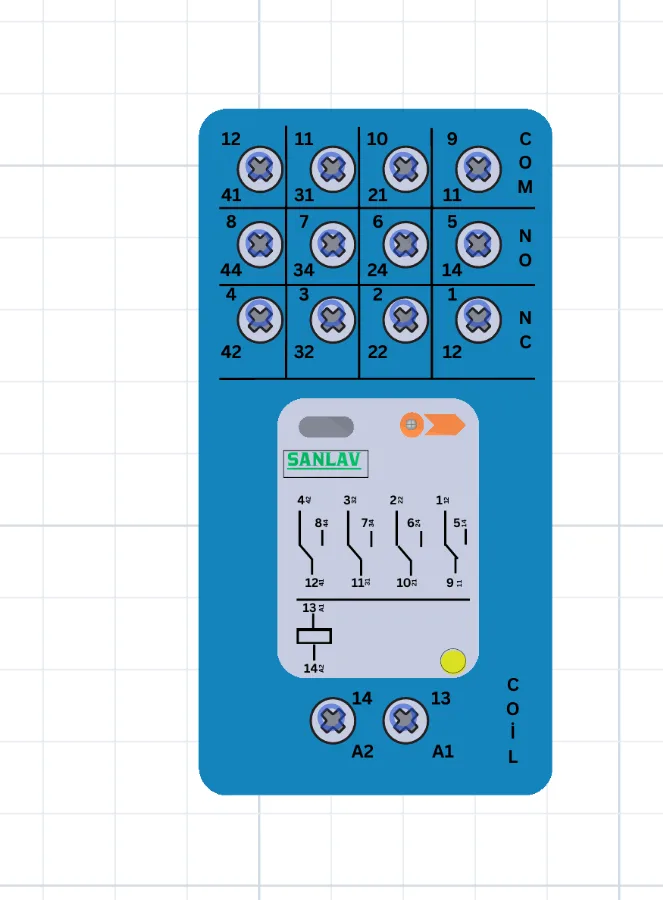
Relays are chosen by coil voltage (12 V DC, 24 V DC, 230 V AC and so on), number of contacts and contact rating. 8-, 11- and 14-pin types are common; a 14-pin relay has four changeover contacts. Each changeover contact has a common (COM), a normally open (NO) and a normally closed (NC) terminal. Models with an LED that lights when the coil is energized and a test button make troubleshooting easier.
What to watch out for
Wire the socket by comparing the pin numbers with the diagram printed on the relay; connecting the wrong pin on relay sockets is a common mistake. The contact rating must be higher than the current of the load. A diode across DC coils and an RC suppressor across AC coils extend contact life.
Terminals
Relay (14-pin)
- Coil
- 13 (A1), 14 (A2)
- Common (COM)
- 9, 10, 11, 12
- Normally open (NO)
- 5, 6, 7, 8
- Normally closed (NC)
- 1, 2, 3, 4
Try it in the simulator.
This component is in CoilPath with its real look. Add it to a circuit, wire it and see how it behaves in the simulation.