Limit switch
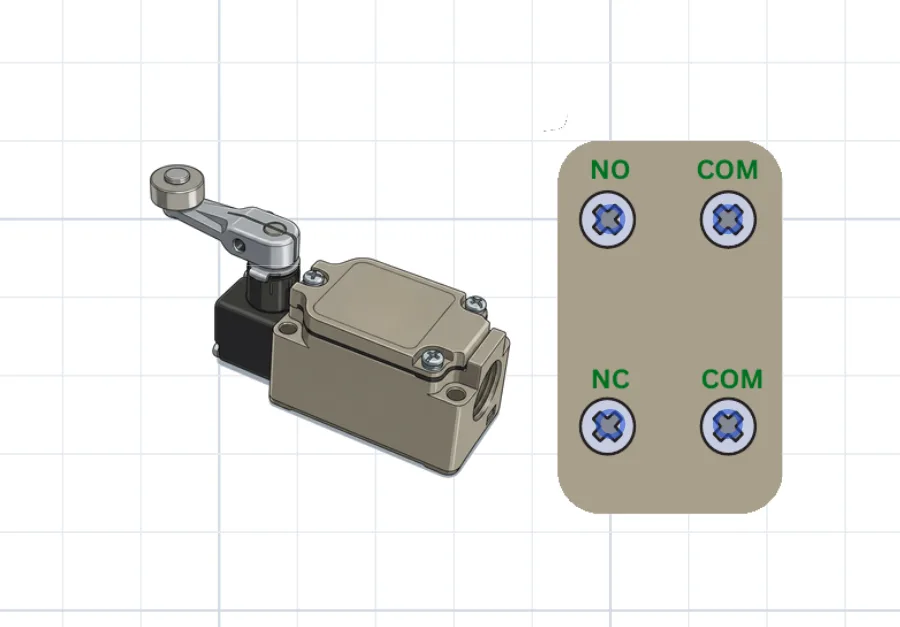
What is a limit switch?
A limit switch is a mechanical switch that changes its contacts when a moving part touches it. It has an actuator head such as a roller lever, plunger or spring rod.
Where is a limit switch used?
It is used on garage and industrial doors, cranes, lifts, conveyors, machine tools and moving mechanisms to detect that a part has reached its end position and to stop the movement. It is also used for safety, to stop a machine when a cover or guard is opened.
Types
There are roller lever, adjustable lever, plunger and spring rod types. Inside there is usually one normally open (NO) and one normally closed (NC) contact. Metal and plastic housings with different protection ratings are available.
What to watch out for
Limit switches used to stop end travel are wired with NC contacts, so the movement stops if the cable breaks. Because they work by mechanical contact, they wear and can go out of adjustment over time; they need regular checks. Where contactless detection is needed, inductive sensors can be used instead.
Terminals
Limit switch
- Normally open contact
- COM-NO
- Normally closed contact
- COM-NC
Try it in the simulator.
This component is in CoilPath with its real look. Add it to a circuit, wire it and see how it behaves in the simulation.