Control transformer
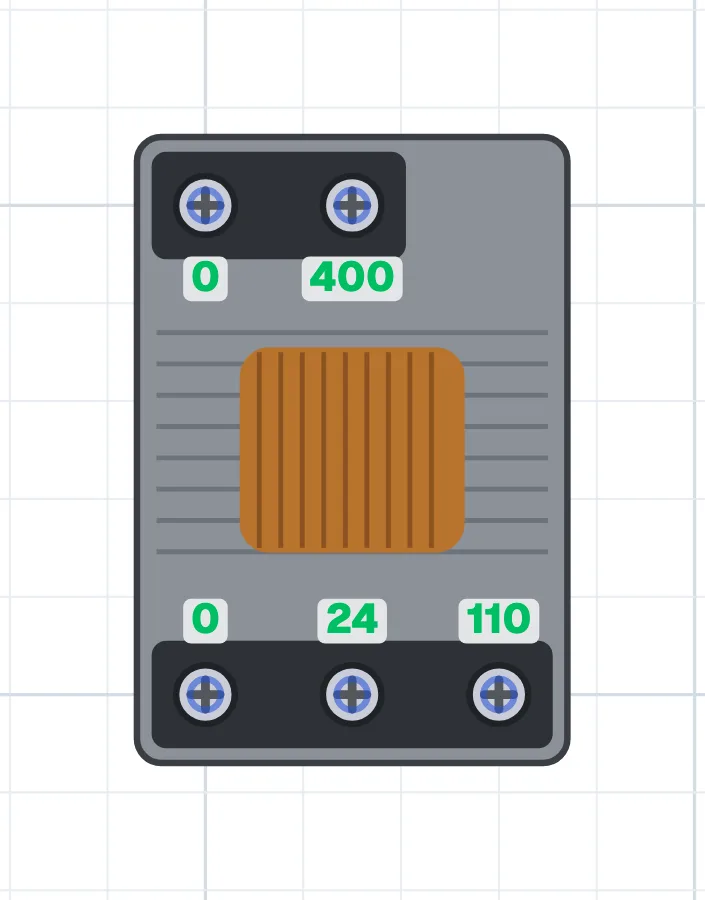
What is a control transformer?
A control transformer is a small transformer that steps the mains voltage down to a lower, isolated voltage for the control circuit. The primary winding goes to the mains, the secondary to the control circuit; the two windings are electrically isolated from each other.
Where is a control transformer used?
It is used in machine panels, lift and crane controls and panels without a neutral to obtain a control voltage and to improve safety by isolating the control circuit from the mains. It is preferred where low-voltage control (24 V, 48 V and so on) is required.
Types and selection
Control transformers are chosen by power (VA) and primary and secondary voltage taps. Many models have several voltage terminals on each side (for example primary 0-230-400 V, secondary 0-24-110 V). The power is chosen to cover the inrush of contactor coils when they pull in.
What to watch out for
Use suitable fuses on the primary and secondary. Connect to the correct voltage terminals according to the diagram on the transformer; using the wrong terminal changes the secondary voltage. Earthing one end of the secondary follows the regulations.
Terminals
Control transformer
- Primary (input)
- top terminals
- Secondary (output)
- bottom terminals
Try it in the simulator.
This component is in CoilPath with its real look. Add it to a circuit, wire it and see how it behaves in the simulation.