Cam switch
What is a cam switch?
A cam switch (rotary cam switch, changeover switch) is a multi-position switch whose internal cam mechanism opens and closes different contacts as its rotary handle is turned. It can be used in both control and power circuits.
Where is a cam switch used?
It is used as a main on-off switch, a voltmeter and ammeter selector, for motor reversing, manual star-delta starting, speed selection and mains-generator changeover. It is common in older motor panels and on agricultural machinery.
Types
There are many types depending on number of poles, current rating and switching diagram: 0-1 on-off, 1-0-2 changeover or reversing, voltmeter selectors and more. It is mounted on the panel door or front, and its handle usually turns in 60° or 90° steps.
What to watch out for
Wiring follows the cam diagram in the manufacturer's catalogue; two cam switches that look the same can be wired differently inside. The current rating is chosen for the load it switches. When reversing a motor, do not turn the switch to the opposite direction before the motor has stopped completely.
Terminals
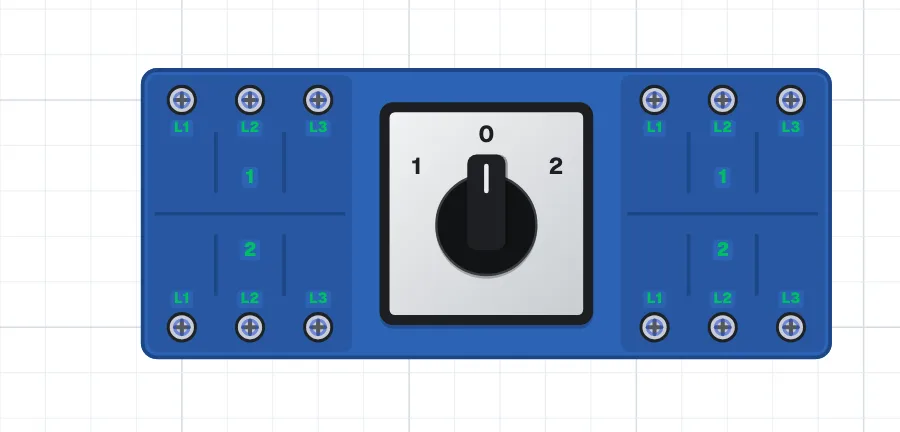
Cam changeover switch
- Position 1 input (mains)
- upper left L1 L2 L3
- Position 2 input (generator)
- lower left L1 L2 L3
- Output (load)
- upper right and lower right L1 L2 L3
Try it in the simulator.
This component is in CoilPath with its real look. Add it to a circuit, wire it and see how it behaves in the simulation.